

 Mercury
Top Discharge Air Cooler Supplier in Kolkata
- Airflow18,000 CMH
- Coverage1000 – 1200 sq. ft.
- Running load1.1 units/hr
Evaporative coolers and exhaust fans from 10,000 to 62,000 CMH, built by us and supplied direct across Kolkata - sized for your space before you buy.
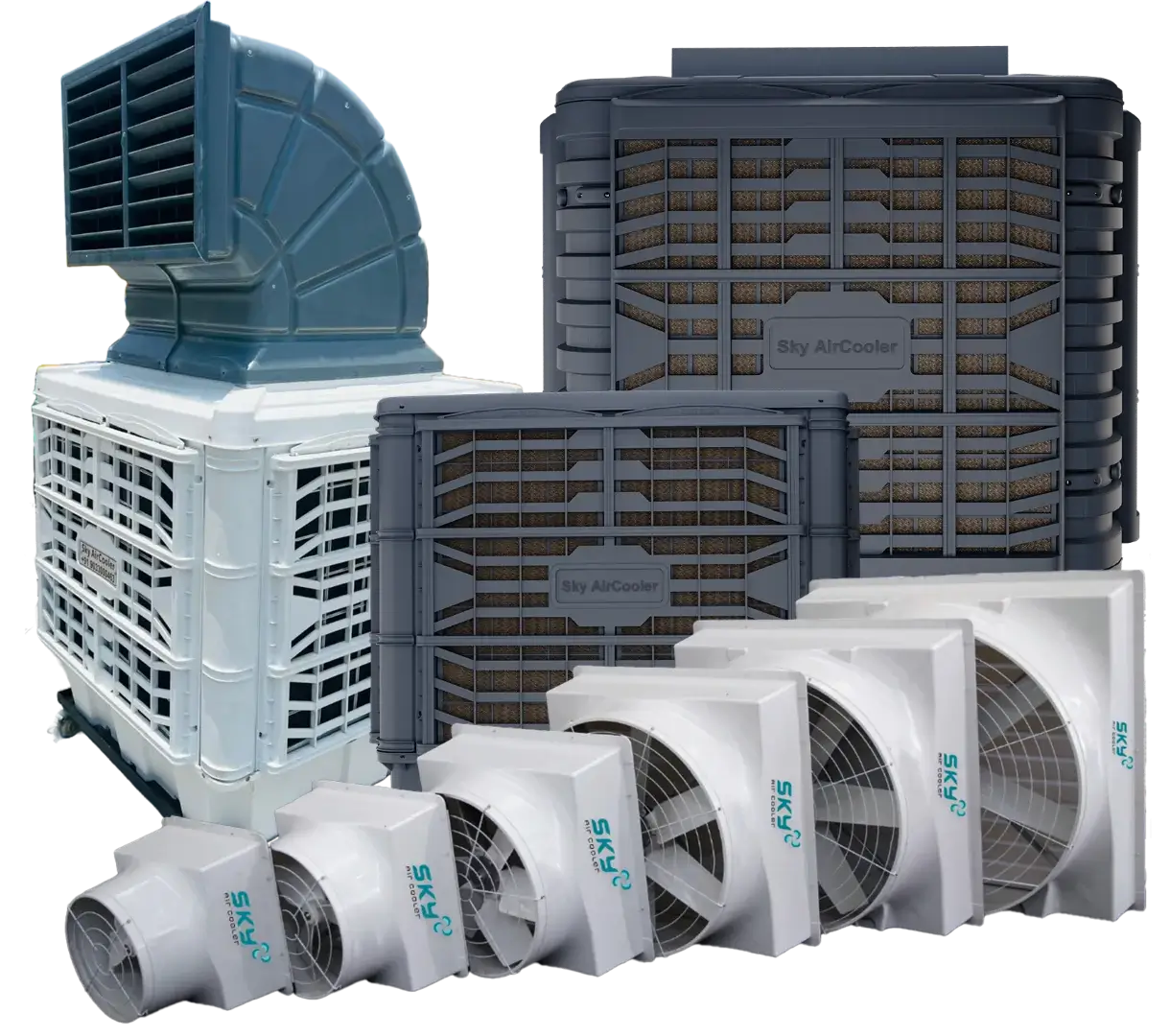
Sky Air Cooler designs and builds every unit in-house. The specification you are quoted is the one that gets made, spares come from the people who made it, and the engineer sizing your space is the one who knows how the unit is put together.
Kolkata is damp for most of the year, so the honest starting point is that the temperature drop here is small - the air already carries too much moisture for evaporative cooling to do much with. The city has a second characteristic that matters more to the specification than the weather does. A great deal of industry here works out of old multi-storey premises rather than single-storey sheds, and a stacked building behaves completely differently: heat rises floor by floor, the top floor is unworkable by afternoon while the ground floor is tolerable, and stairwells and lift shafts pull air in directions nobody planned. Cooling a building like that is a floor-by-floor question, not a single number.
An evaporative cooler works differently. A pump keeps honeycomb pads wet, a blower pulls outside air through them, and the water takes heat out of that air as it evaporates. What reaches the floor is cooler, and because the supply is fresh outside air rather than recirculated air, the building gets a continuous change of air as well. Where welding fumes, solvent vapour or cotton lint would otherwise hang around, that exchange matters as much as the temperature drop.
This is the range that goes into production sheds, godowns and plants around Naroda, Vatva and Odhav. The units run from 18,000 to 40,000 CMH, and one of them will cover roughly 1,000 to 3,200 sq. ft. depending on the model and how high the roof sits. Bodies are built for a working floor - dust, vibration and long shifts - rather than for an office.
The Mercury, Pluto, Venus and Neptune models come in both top and bottom discharge. Bottom discharge drops air straight into the working level and suits an open floor. Top discharge sends it upward, which is what a high roof needs, and it is also the version that takes ducting.
Mercury
 Mercury
 Uranus
 Pluto
Pluto
 Pluto
Pluto
 Jupiter
 Venus
Venus
 Venus
Venus
 Neptune
 Neptune
The Earth range sits on castors from 18,000 to 25,000 CMH, so it can be wheeled to wherever people actually are. No ducting, no civil work, and a single socket to run it. Showrooms, banquet halls, temples, canteens and open seating are the usual homes for these, along with any floor where the layout changes from week to week.
Because they are movable, they also work as a stop-gap while a permanent installation is being planned, or as extra capacity for the two or three worst months of the year.
 Earth
Earth
 Earth
Earth
Earth
Earth
Coolers push cooled air in. Exhaust fans give the hot air already sitting in the building somewhere to go, and without that the cooling stalls after an hour or two. The Skyex range covers 10,000 to 62,000 CMH across five sizes, including a nylon-blade version for humid and corrosive spaces such as dyeing houses and chemical units.
On most Kolkata sites we specify the two together and set the fans on the opposite wall to the coolers, so the air crosses the floor rather than circling one end of it.
 Skyex
Skyex
 Skyex
Skyex
 Skyex
Skyex
 Skyex
Skyex
 Skyex
Skyex
HVLS is high volume, low speed - a large blade turning slowly, pushing a wide column of air across a floor instead of the narrow blast a pedestal fan gives you. The S130, S150 and S200 run at 30,000, 42,000 and 55,000 CMH, cover roughly 2,000, 3,000 and 4,000 sq. ft. each, and draw only 0.45 to 1.1 kW while doing it.
On sites around Kolkata, these go in where evaporative cooling is the wrong tool - a humid stretch of the year, a packing hall where the extra moisture is a problem, or a shed with the shutters open all day. They run dry, sit on castors and plug into an ordinary socket, so one fan can follow the work from bay to bay instead of being fixed to a wall.
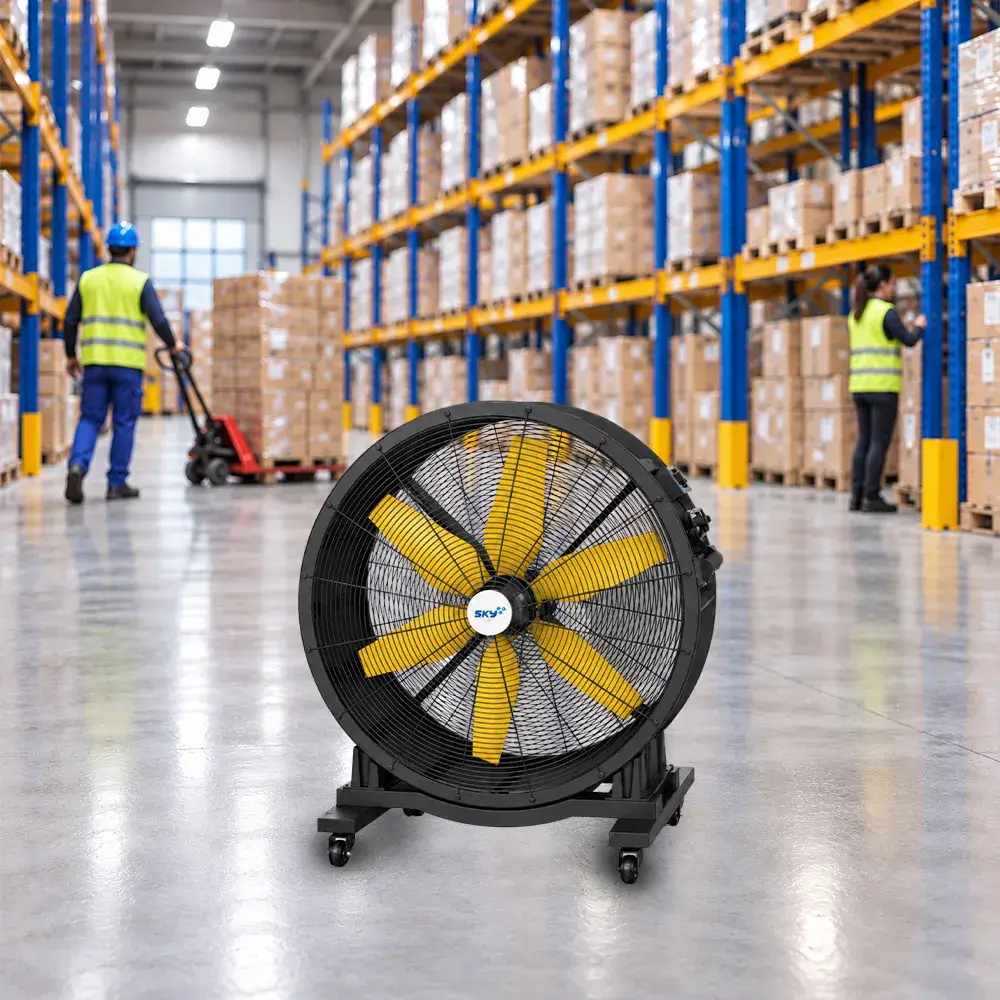 S130
S130
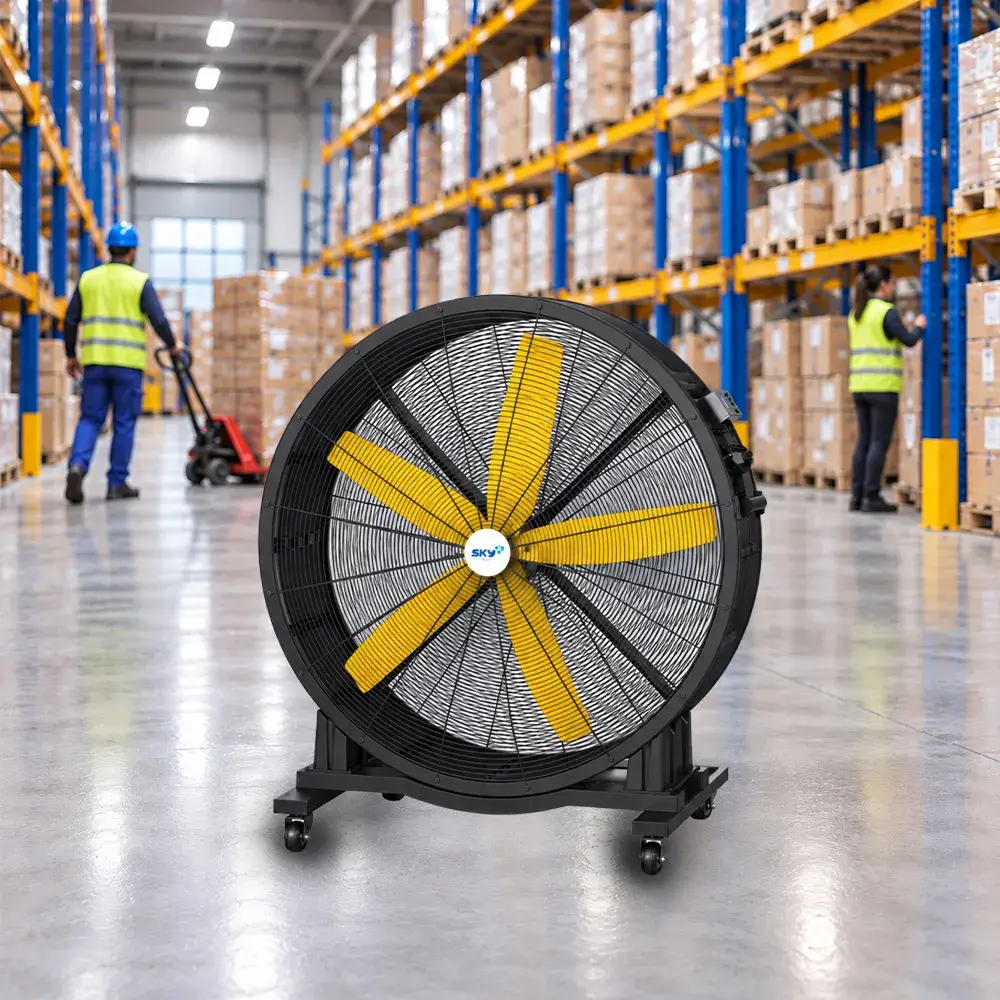 S150
S150
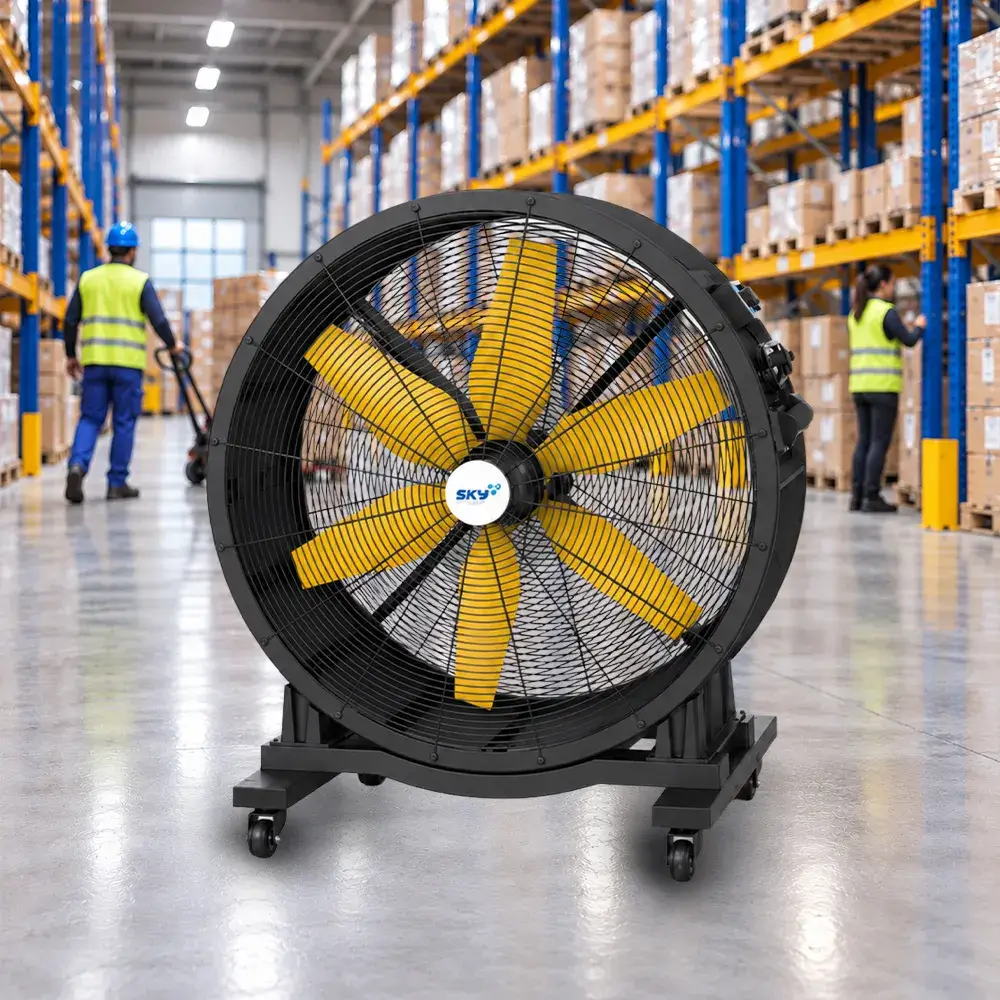 S200
S200
We do not just sell a cooler. We study your shed, calculate the heat load, design the layout, manufacture the unit and stay with you after installation.
Full control over air coolers, body, motor, axial fans, pads and assembly means consistent quality and faster delivery.
Experienced engineers who understand airflow, heat load and ventilation - not just product catalogues.
Survey, design, ducting, installation, commissioning and AMC handled by a single accountable team.
Supplying India, USA, UAE, Saudi Arabia, Germany, Denmark, Australia, Greenland and the EU.
Lower purchase price, far lower running cost and minimal spares expense over the product life.
Dedicated service number, stocked spare parts and quick response for breakdown support.
Textile mills, plastic and rubber units, foundries, packaging lines, cold-chain godowns, engineering workshops and poultry sheds - wherever heat, humidity or fumes make work uncomfortable, a Sky Air Cooler installation makes a measurable difference.


Different buildings need different answers. These are the ones we are asked for most.
A finishing floor in a multi-storey unit at Tangra, an engineering workshop at Taratala and a packaging and print hall near Dum Dum each shed heat differently, hold humidity differently, and have their own rules about where a unit can physically go. The six below cover most of what we are asked to quote, and in Kolkata the shape of the building decides the answer more than its floor area does.
A godown cooler has to throw air a long way down a narrow building without leaving dead corners at the back. High-CMH units spaced along the length do that, and the constant fresh-air exchange keeps stored goods from sitting in stale, damp air.
Machine heat stacks on top of the outside temperature, so the cooler has to run all shift without adding much to the bill. Metal bodies handle the dust and the vibration that come with a working floor.
Where the layout is fixed, a duct cooler feeds cooled air through ducting to outlets over each work area. It is the usual answer for long assembly lines and anywhere floor space cannot be given up to standing units.
Spinning, weaving and dyeing all throw off heat and lint. Steady airflow keeps operators comfortable and stops warm, still air settling over the machines.
Presses and sealers run hot, and the people working them are on their feet all day. A jumbo cooler over the line brings the working temperature down without the condensation an air-conditioned room would put on the stock.
Welding bays, fabrication floors and service workshops need heat and fumes moved out as much as they need cool air in. Coolers and exhaust fans together do both.
Worked at 30 air changes an hour, which is what an industrial shed normally needs. Unit counts are for the Venus Top Discharge Air Cooler at 30,000 CMH - a bigger model brings the count down.
| Floor area | Roof height | Airflow required | Coolers needed |
| 5,000 sq. ft. | 20 ft | 84,950 CMH | 3 units |
| 8,000 sq. ft. | 20 ft | 135,921 CMH | 5 units |
| 10,000 sq. ft. | 20 ft | 169,901 CMH | 6 units |
| 15,000 sq. ft. | 22 ft | 280,336 CMH | 10 units |
| 20,000 sq. ft. | 25 ft | 424,752 CMH | 15 units |
These are starting figures. Machine heat, how many people are on the floor and how much of the shed is open all move the number, which is why we survey before we quote. Work out your own figure on the cooling calculator.
Sizing starts from volume rather than floor area, because roof height changes the answer completely. Two sheds with the same footprint but a 20 ft and a 28 ft roof need very different airflow, and quoting off square feet alone is the most common reason a cooling system underperforms once it is in. We take length, width and height, apply the air changes an hour the space needs, and the layout then decides where the units sit so that no corner is left still.
Two questions come up on every enquiry, and the honest answer to both depends on your building.
There is no compressor and no refrigerant gas in an evaporative cooler - a pump, a blower and a set of pads. Across the range the units draw between 0.37 and 3.7 units an hour depending on size, and that gap against an air-conditioned floor of the same area is where the saving sits. Water use follows the weather; the industrial models hold 35 to 45 litres, and on a floor running full shifts we normally connect a continuous supply so nobody is refilling by hand.
Upkeep is straightforward. The tank, pads and filters want cleaning about every two weeks in season to stop mineral deposits and algae building up, and the motor and pump are worth a check before summer starts. Price itself moves with the airflow rating, the number of units the layout needs, whether it is ducted or free-standing, and the installation - which is why we quote against your shed rather than publish a list.
Our range is rated between 0.37 and 3.7 units an hour depending on the model. A 30,000 CMH cooler at 3 units an hour, run ten hours a day, works out near 900 units a month.
There is no compressor and no refrigerant gas - only a pump and a fan. That is what takes the electricity down by up to 80% against an air-conditioned floor of comparable size.
Airflow rating, how many units the layout needs, ducting against free-standing, and installation. No two sheds price the same, so we quote against yours rather than publish a list.
Send the floor area, roof height and what runs inside. A quotation with the unit count and a layout suggestion comes back within one working day, at no charge.

Our weaving floor used to touch 44°C in May. After installing eight Sky coolers the temperature stays comfortable through the shift and our labour attendance has clearly improved.
We compared three vendors. Sky was the only one that came, measured the shed and gave a proper layout drawing before quoting. The installed airflow matched exactly what they promised.
Running cost was the deciding factor for our 40,000 sq. ft. warehouse. The electricity bill is a fraction of what an air-conditioning system would have cost us every month.
Service response has been genuinely quick. Pads and pump were replaced under the maintenance contract without us having to follow up repeatedly.
The shed doors stay open all day, so air conditioning was never an option for us. These coolers dropped the floor temperature noticeably without changing how we work.
Installation was finished inside the shutdown window they committed to. No rework, no surprise costs, and the team cleaned up before leaving.
From automobile plants and pharmaceutical units to universities, dairies and Indian Railways - a few of the names that rely on Sky Air Cooler.


Named areas, not a radius on a map - these are the places we deliver to and come back out to.
We supply across Taratala, Behala, Kasba, Tangra, Dum Dum, Barrackpore, Bantala, Budge Budge, Falta and Ultadanga and the smaller clusters in between. In multi-storey premises we specify floor by floor and pay attention to where the air leaves as much as where it enters, because in a stacked building an extract in the wrong place will simply pull hot air up from the floor below.
The work is a mix. Leather and finishing units through Tangra and the Bantala complex, engineering, fabrication and light manufacturing across Taratala, Behala and Barrackpore, printing, packaging and garment floors around Kasba and Ultadanga, chemical and processing plants towards Budge Budge and Falta, plus the distribution warehousing that serves eastern India. Send the floor area, the roof height and a note on what runs inside, and a quotation comes back within one working day with the airflow figure, the unit count, a layout suggestion and the price - no charge, no obligation.
Yes. We are the manufacturer, and we supply in Kolkata directly as well as through our dealer network. Because the city is humid and much of it is multi-storey, we will usually recommend a different balance of coolers to exhaust fans than we would for a single-storey shed inland, and we will explain why on the quotation.
Send us the floor area, roof height and what runs inside. We work out the airflow in CMH, the number of units and where they should sit, then send back a layout drawing and a quotation. There is no charge for the sizing.
An evaporative cooler uses a pump and a fan rather than a compressor, so it draws a fraction of the power an equivalent AC system would. Across the range our units are rated between 0.37 and 3.7 units per hour depending on the model.
Units go by road from our Gujarat plant, so Kolkata is one of the longer domestic runs we handle and the transit time is part of the schedule rather than an afterthought. We confirm a firm date along with the quotation, and for upper floors it is worth telling us about access and lift capacity at the enquiry stage.
Honestly, the drop in Kolkata is small - the air is damp through most of the year and damp air cannot take up much more moisture. What does the work here is the airflow and the fresh-air exchange, and in a multi-storey building that means getting hot air off the upper floors and out rather than letting it stack. That works whatever the weather is doing outside.
Our industrial models carry a 35 to 45 litre tank depending on the unit, and how fast that goes down depends on how hot and how dry the day is. For a shed running full shifts we normally connect a continuous water supply so nobody has to keep refilling by hand.
Clean the tank, cooling pads and filters roughly every two weeks in season to stop mineral deposits and algae building up, and have the motor and pump checked before summer starts. There is no compressor or gas circuit to service.
Coolers carry a manufacturer warranty on the body and motor, with defined terms for pads, pumps and other consumables. Full terms are on our warranty page.
Yes. Top discharge units are built to take ducting, so cooled air can be carried to outlets over particular machines or work stations instead of being thrown across the whole floor. It is the usual approach for long assembly lines and anywhere floor space cannot be given up to standing units.
Top discharge sends the air upward, which suits ducting or a high roof where the air is meant to spread and fall. Bottom discharge pushes it down into the working level directly, which is better for open floors without ducting. We recommend one or the other once we have seen the layout.
Send us the area, the roof height and what runs inside - we will work out the CMH, the unit count and the placement.