

Key Takeaways
- Rooftop exhaust fans are essential for removing accumulated heat, smoke, and process fumes in industrial factories.
- Choose a qualified Roof Top Exhaust Fan Manufacturer to ensure effective air-extraction system planning.
- Proper fan placement and airflow direction are crucial for maximizing factory ventilation efficiency.
- Evaluate your factory's specific requirements, such as equipment type and building height, before selecting an exhaust fan.
- Integrating rooftop exhaust fans with cooling systems enhances air movement and maintains comfortable indoor conditions.
Sky Air Cooler, is a leading manufacturer of industrial exhaust fans and fresh-air cooling solutions for factories and industrial facilities. In manufacturing spaces, heat naturally rises and can collect near the roof, while smoke, process fumes and stale air can make indoor conditions uncomfortable. Working with an experienced Roof Top Exhaust Fan Manufacturer can help businesses plan an effective air-extraction system that continuously moves unwanted hot air out of the building.
Why Hot Air Builds Up Inside Industrial Factories
Factories can generate substantial internal heat from machinery, production processes, electrical equipment, lighting and continuous human activity. Because warm air rises, a large portion of this heat moves toward the upper section of the shed or factory building.
If that hot air has no effective exit path, it can remain trapped inside the structure. Fresh air entering through doors or other openings may not be enough to create the required air movement.
The purpose of rooftop exhaust ventilation is to give accumulated hot and stale air a planned route out of the building.
This approach can be particularly useful in large industrial sheds where natural ventilation alone cannot provide suitable air exchange throughout the working area.
How Rooftop Exhaust Fans Support Fresh-Air Industrial Cooling
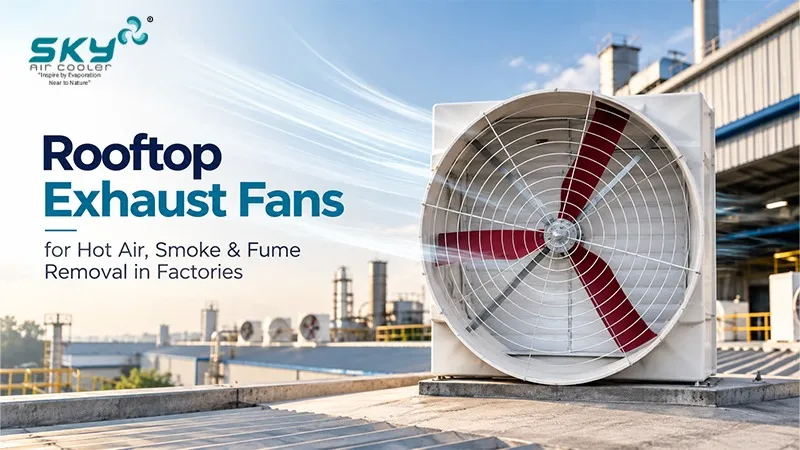
A rooftop exhaust fan creates outward airflow by extracting indoor air from a high point in the building. As warm air accumulates near the roof, the fan discharges it outside and supports the movement of replacement air into the facility.
The basic airflow process can be understood in four stages:
- Heat, smoke and process-generated air rise toward the upper area of the factory.
- Rooftop exhaust fans draw this accumulated air toward the extraction point.
- The extracted air is discharged outside the building.
- Fresh replacement air enters through planned air inlets, openings or an industrial cooling system.
When the exhaust and fresh-air sides are properly planned together, the facility gets continuous air movement instead of simply circulating the same warm indoor air.
Removing Heat, Smoke and Process Fumes
Industrial ventilation is not only about temperature. Certain factory operations can also create smoke, odours, fumes, airborne process heat and stale indoor air.
Rooftop extraction can help remove these contaminants from the general factory environment by continuously replacing indoor air with fresher incoming air. The actual fan selection and ventilation layout should be based on the facility, processes, airflow requirement and location of the exhaust points.
For applications involving specific hazardous or regulated substances, businesses should use ventilation systems designed for the particular process and applicable safety requirements rather than treating a general-purpose exhaust fan as a specialised extraction system.
Choosing a suitable Roof Top Exhaust Fan Manufacturer therefore involves more than selecting a fan based only on its physical dimensions.
Rooftop Exhaust Fans and Evaporative Cooling Work Together
Industrial cooling works better when incoming fresh air and outgoing hot air are treated as parts of the same airflow system.
The product page specifically explains that cooling a shed without extracting air can simply recirculate heat. It describes pairing Skyex exhaust fans with coolers to create a push-pull airflow loop.
In this arrangement, evaporative air coolers supply cooled fresh air while exhaust fans provide an outlet for warmer indoor air. Balanced air movement helps prevent heat from continuously accumulating inside the factory.
This combination can be useful for manufacturing sheds, warehouses and other large industrial spaces where continuous fresh-air movement is a priority.
What Should B2B Buyers Check Before Selecting a Rooftop Exhaust Fan?
A factory ventilation requirement should be evaluated according to the building rather than selecting a fan only from a catalogue. Before approaching a Roof Top Exhaust Fan Manufacturer, buyers should review the main factors that affect fan selection.
- Factory floor area and building height
- Type and location of heat-generating equipment
- Existing doors, louvers and fresh-air openings
- Expected airflow or air-change requirement
- Roof structure and proposed fan installation points
- Presence of smoke, fumes or process-generated contaminants
- Existing cooling, ventilation or ducting systems
These details give the manufacturer or ventilation consultant a better basis for recommending fan capacity, quantity and placement.
Why Fan Placement Matters in Factory Ventilation
Installing high-capacity fans without considering airflow direction can leave sections of a factory poorly ventilated.
Rooftop exhaust points should work with the path of incoming fresh air so that air travels through the occupied and heat-generating areas before leaving the building. Factors such as partitions, machinery rows, storage racks and production zones can affect this movement.
That is why airflow planning should consider the complete factory rather than treating each exhaust fan as an isolated unit.
A capable Roof Top Exhaust Fan Manufacturer can use the factory layout and ventilation requirement as the starting point for selecting an appropriate exhaust arrangement.
Automatic Shutters and Industrial Construction
Industrial exhaust equipment is exposed to demanding operating environments, making the fan housing and closure arrangement important considerations.
The Skyex range published by Sky Air Cooler features automatic shutters and corrosion-resistant construction. Automatic shutters provide a practical closure mechanism when airflow through the fan is not required, while corrosion-resistant construction is relevant for equipment operating in industrial environments.
Buyers should also consider accessibility for inspection, cleaning and routine maintenance when determining the final installation location.
Why Choose Us
At Sky Air Cooler, we focus on industrial air movement as part of the overall cooling and ventilation requirement rather than viewing an exhaust fan as a standalone product. Our Skyex range covers airflow capacities from 10,000 to 62,000 CMH, giving industrial buyers multiple options for different ventilation requirements. We work with businesses that need practical fresh-air circulation, heat extraction and industrial cooling solutions based on their facility conditions and airflow needs.
Conclusion
Rooftop exhaust fans play an important role in factories where hot air collects near the roof and continuous ventilation is required to remove heat, smoke, fumes and stale indoor air. An effective system considers both extraction and the supply of replacement fresh air so that air moves through the facility in a planned direction. Working with a knowledgeable Roof Top Exhaust Fan Manufacturer helps buyers evaluate airflow capacity, installation location and integration with existing cooling systems. The right approach can create a more practical fresh-air ventilation arrangement for industrial working spaces.
Planning a rooftop exhaust system for your factory, warehouse or industrial shed? Speak with Sky Air Cooler about your airflow requirement and suitable Skyex industrial exhaust fan options. Call now: +91 6353096801 or email support@skyaircooler.com.
Need trapped heat, smoke and fumes out of your factory?
Share your factory size, application and ventilation requirement with our team to discuss a suitable industrial exhaust solution.
Frequently Asked Questions
A Roof Top Exhaust Fan Manufacturer provides expertise in designing and installing exhaust systems that effectively remove hot air, smoke, and contaminants from industrial spaces. They assess the specific requirements of a facility to recommend appropriate fan types, capacities, and placements for optimal air movement.
Rooftop exhaust fans improve air quality by continuously extracting warm, stale air and replacing it with fresh air. This process not only removes heat but also mitigates the presence of smoke and fumes generated during manufacturing processes, creating a healthier work environment.
When selecting a rooftop exhaust fan, it's essential to evaluate the factory's floor area, building height, type of equipment generating heat, and existing ventilation systems. These factors help determine the appropriate fan capacity, placement, and overall design of the ventilation system.
Fan placement is crucial because it affects how effectively air moves through the facility. Properly positioned fans ensure that fresh air travels through occupied areas and heat-generating equipment, preventing sections of the factory from becoming poorly ventilated.
Yes, rooftop exhaust fans can be integrated with other cooling systems, such as evaporative coolers, to create a balanced airflow loop. This collaboration enhances overall cooling efficiency by ensuring that fresh air enters while warm air is expelled, improving air circulation throughout the industrial space.