

Key Takeaways
- Industrial exhaust fans remove hot air and improve indoor air quality in manufacturing plants.
- Choosing the right industrial exhaust fan manufacturer is crucial for effective ventilation planning.
- Proper fan placement and airflow capacity significantly influence the performance of exhaust systems.
- Industrial exhaust fans help manage fumes, odours and moisture in manufacturing environments.
- Combining exhaust fans with evaporative cooling systems enhances air circulation throughout the facility.
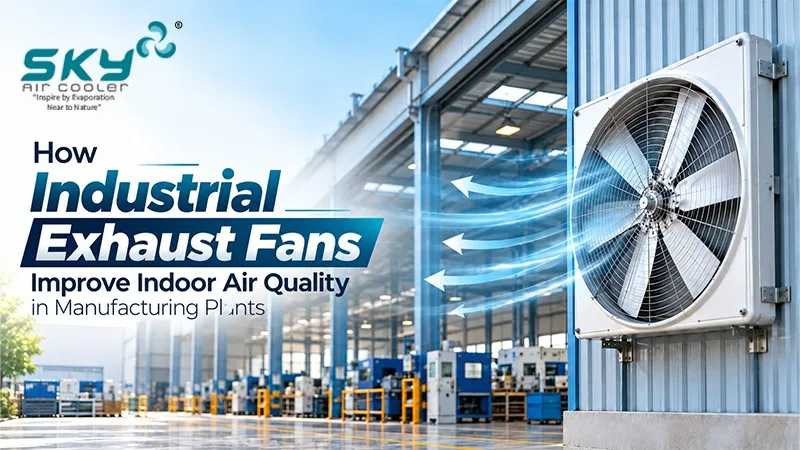
Sky Air Cooler is a leading manufacturer and exporter of industrial exhaust fans. In manufacturing plants, heat, stale air, fumes, odours and airborne particles can build up when ventilation is inadequate. Working with an experienced Industrial Exhaust Fan Manufacturer helps plant owners create a practical exhaust strategy that continuously removes unwanted indoor air and supports better air movement across the facility.
Why Indoor Air Quality Becomes a Challenge in Manufacturing Plants
Manufacturing spaces are very different from offices or homes. Production equipment can release heat, process areas may generate vapours or dust, and large sheds can develop pockets of stagnant air. When this air remains trapped, the working environment can become uncomfortable and ventilation performance can decline.
An exhaust system addresses the problem by pulling used indoor air out of the building. Fresh replacement air can then enter through planned openings or through a coordinated ventilation and cooling arrangement. The main objective is not simply air movement; it is controlled removal of unwanted indoor air.
For B2B buyers, the system must suit the building size, process layout, heat sources, available air inlets and required air-change pattern. This is why choosing among Industrial Exhaust Fan Manufacturers should involve more than comparing fan size alone.
How Industrial Exhaust Fans Support Better Air Quality
Industrial exhaust fans improve indoor conditions by creating a continuous path for stale air to leave the plant. Their effectiveness depends on correct positioning, airflow capacity and the way fresh air enters the space.
In a well-planned setup, the process typically works in this order:
- Hot, stale or process-affected air accumulates inside the manufacturing area.
- Exhaust fans draw this indoor air toward designated outlet points.
- The extracted air is discharged outside the plant.
- Fresh replacement air enters through openings or a planned cooling and ventilation system.
- Continuous extraction reduces stagnant zones and supports more consistent air circulation.
Sky Air Cooler explains that cooling a shed without extracting air only recirculates the heat, and its Skyex exhaust fans can be paired with coolers to create a complete push-pull loop.
Key Ways Exhaust Fans Help Manufacturing Environments
A properly selected fan from an Industrial Exhaust Fan Manufacturer can support indoor air quality in several practical ways, depending on the process and ventilation design.
- Heat removal: Exhaust fans help remove accumulated hot air from machinery, production activity and the building itself.
- Stale air extraction: Continuous exhaust helps prevent indoor air from remaining trapped for long periods.
- Fume and odour control: Where processes release non-confined fumes or odours, general exhaust can help move affected air out of the work area.
- Air circulation support: Exhaust creates directional movement that helps replacement air travel through the plant.
- Moisture management: In suitable applications, exchanging indoor air can help reduce excess humidity or process-related moisture buildup.
- Support for evaporative cooling: Exhaust fans can complement evaporative coolers by providing an outlet path for indoor air.
For processes involving hazardous dusts, gases or chemical emissions, general exhaust fans should not be treated as a substitute for engineered source-capture or process-specific ventilation systems. Plant owners should use the ventilation method appropriate to the process.
Why Fan Capacity and Placement Matter
Airflow capacity is one of the main technical factors in exhaust planning. A fan that is too small for the space may not remove air effectively, while poor placement can leave dead zones even when the installed airflow appears adequate.
The Skyex industrial exhaust fan range from Sky Air Cooler includes five wall and roof fan models with stated airflow capacities from 10,000 CMH to 62,000 CMH. The product page also states that the range uses automatic shutters and a corrosion-resistant build.
|
Skyex Model |
Airflow |
Running Load |
Speed |
|
Skyex 650 |
10,000 CMH |
0.37 units/hr |
1400 RPM |
|
Skyex 850 |
13,000 CMH |
0.37 units/hr |
700 RPM |
|
Skyex 1060 |
29,000 CMH |
0.55 units/hr |
460 RPM |
|
Skyex 1460 |
44,500 CMH |
1.1 units/hr |
540 RPM |
|
Skyex 1460 Nylon |
62,000 CMH |
2 units/hr |
700 RPM |
These published specifications show why Industrial Exhaust Fan Manufacturers should help buyers compare required airflow with the available model range rather than choosing by physical fan dimensions alone. An experienced Industrial Exhaust Fan Manufacturer can also help match airflow requirements with plant layout and ventilation goals.
Exhaust Fans and Evaporative Cooling Work Better Together
In many manufacturing plants, cooling and exhaust are connected parts of the same airflow strategy. Evaporative air coolers introduce fresh cooled air, while exhaust fans provide a defined path for warmer indoor air to leave.
Without a suitable outlet, cooled air may not travel through the facility as intended. With planned extraction, fresh air can move from supply points toward exhaust points, creating a more useful airflow pattern across working zones.
For plant owners evaluating Industrial Exhaust Fan Manufacturers, it is valuable to consider whether the supplier understands both cooling and extraction. A coordinated approach can make system planning more practical for large sheds, production areas and other industrial spaces.
What B2B Buyers Should Check Before Selecting an Exhaust Fan
Before finalising an industrial exhaust fan, buyers should review the complete application.
- Check the approximate area, height and layout of the manufacturing space.
- Identify major heat-producing machines and process zones.
- Note where fresh replacement air can enter the building.
- Review the required airflow and proposed exhaust locations.
- Check whether wall-mounted, roof-mounted or another configuration suits the layout.
- Confirm the fan specifications, installation requirements and service support.
A reliable Industrial Exhaust Fan Manufacturer should be able to discuss these factors in relation to the actual plant instead of recommending equipment without understanding the application.
Why Choose Us
Sky Air Cooler focuses on industrial cooling and ventilation solutions for real plant environments. Our Skyex range covers airflow from 10,000 to 62,000 CMH across five wall and roof fan models, with automatic shutters and corrosion-resistant construction stated on our product page. We also understand the relationship between air supply and extraction, which helps us approach manufacturing plant ventilation as a complete airflow requirement rather than treating the exhaust fan as an isolated component.
Conclusion
Indoor air quality in a manufacturing plant depends heavily on how effectively unwanted indoor air is removed and replaced. Industrial exhaust fans help discharge heat, stale air, odours and process-affected air while supporting better circulation across large workspaces. Correct airflow capacity, fan position and replacement-air planning are central to the result. When comparing Industrial Exhaust Fan Manufacturers, B2B buyers should look for a supplier that can connect fan selection with the actual plant layout, operating conditions and overall ventilation plan. A properly planned exhaust system can make the indoor environment more comfortable and ventilation more effective.
Planning a new exhaust system or upgrading ventilation in your manufacturing plant? Speak with Sky Air Cooler about the Skyex industrial exhaust fan range and your airflow requirement. Call +91 6353096801 or email support@skyaircooler.com to discuss your plant application and request a suitable solution.
Planning exhaust ventilation for your plant?
Share your plant layout, heat sources and airflow requirement with our team and get guidance on a suitable Skyex industrial exhaust fan arrangement.
Frequently Asked Questions
Industrial exhaust fans help improve indoor air quality by continuously extracting stale and hot air, reducing humidity, and controlling fumes and odors. They enhance air circulation, making the work environment more comfortable for employees.
Selecting the right industrial exhaust fan involves assessing your manufacturing space's area, layout, and heat sources. It's essential to work with an experienced Industrial Exhaust Fan Manufacturer to match fan size, capacity, and placement with your specific ventilation needs.
Proper fan placement is crucial for effective airflow. Incorrect positioning can lead to stagnant zones where air fails to circulate, compromising indoor air quality and the overall effectiveness of the ventilation system.
Yes, industrial exhaust fans can efficiently work alongside evaporative cooling systems. The exhaust fans provide a defined outlet for warm indoor air, allowing cooled air to effectively circulate throughout the facility.
When evaluating Industrial Exhaust Fan Manufacturers, consider their understanding of complete airflow strategies, product specifications, and support services. It's important to ensure that they can help you plan for both exhaust and fresh air supply tailored to your specific plant layout.