

Key Takeaways
- High-static ducting air coolers ensure effective air distribution in large sheds and warehouses, improving worker comfort and productivity.
- Ductable air cooler systems combine evaporative cooling with a well-planned air distribution setup for industrial applications.
- Selecting the right duct design is crucial for maximizing the performance of a central ducting cooler.
- Sky Air Cooler specializes in ducting air cooler manufacturing, offering tailored solutions for various industrial environments.
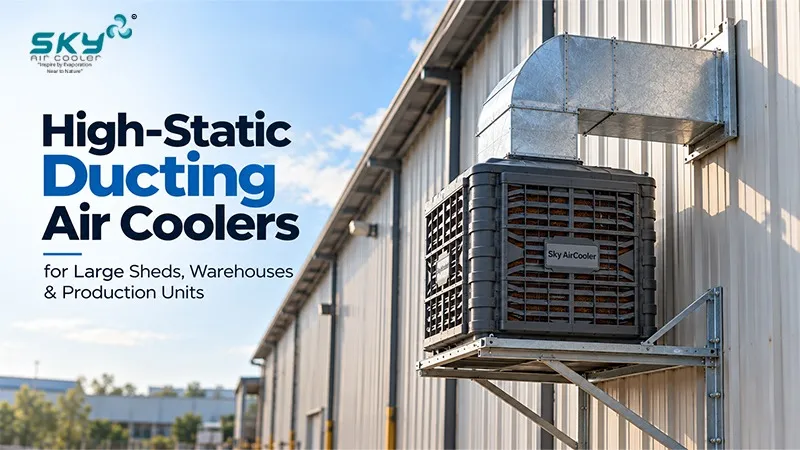
- High-static ducting air coolers ensure effective cooled air distribution in large industrial spaces.
Sky Air Cooler, is a leading manufacturer and exporter of industrial evaporative air cooling solutions. Large sheds, warehouses and production units need more than basic air movement; they need cooled fresh air delivered effectively across wide working areas. As a Ducting Air Cooler Manufacturer, we provide high-static industrial evaporative cooling solutions designed for applications where air needs to travel through properly planned duct networks.
Why High-Static Cooling Matters in Large Industrial Spaces
Large industrial buildings often have high roofs, wide floor areas, machinery, storage racks and multiple work zones. A standard cooler placed at one location may not distribute air effectively to all required areas.
A high-static cooling arrangement is designed to move cooled air through ducting and deliver it closer to targeted work zones. The objective is not simply to generate cool air, but to distribute it where workers and processes actually need it.
Our industrial evaporative coolers use four-side honeycomb cooling pads and high-static blowers for large sheds and production environments. The current industrial range includes models with airflow capacities from approximately 18,000 to 40,000 CMH.
How a Ductable Industrial Air Cooler Works
A Ductable Air Cooler For Industrial applications combines evaporative cooling with a planned air-distribution system. Instead of relying only on free air discharge around the cooler, cooled air is directed through ducts to selected points inside the building.
The basic process follows a clear sequence:
- Warm outside air is drawn into the industrial air cooler.
- The air passes through water-saturated honeycomb cooling pads.
- Heat from the incoming air is absorbed during the evaporation process.
- The high-static blower pushes the cooled air into the connected duct system.
- Duct outlets distribute fresh cooled air across selected working zones.
Unlike conventional refrigerated air-conditioning, evaporative cooling uses water and airflow rather than chemical refrigerants, while continuously introducing fresh outside air.
Where Central Ducting Systems Are Most Useful
A properly designed Central Ducting Air Cooler system can be suitable where a single cooling point cannot adequately serve the complete working floor.
Typical industrial applications include:
- Manufacturing and production sheds
- Large warehouses and godowns
- Engineering and machine-tool units
- Textile and processing facilities
- Automobile and component manufacturing areas
- Food and agro-processing units
- Large workshops with open or semi-open operating conditions
In these environments, the duct route can be planned around equipment placement, workstations, storage areas and movement paths rather than treating the entire shed as one uniform space.
Central Ducting Cooler vs Direct-Discharge Cooling
The appropriate configuration depends on the building layout and where cooled air needs to reach.
| Factor | Direct-Discharge Cooler | Central Ducting Cooler |
| Air delivery | Around the installation point | Through planned duct routes |
| Suitable layout | Open, comparatively simple spaces | Large or divided industrial floors |
| Air direction | Local discharge | Multiple selected discharge points |
| Distribution planning | Limited | Layout-based |
| Typical use | Open working areas | Sheds, warehouses and production units |
For high-roof buildings or areas where the cooler cannot be positioned close to employees, ducting can provide a more practical method of directing cooled air toward occupied zones.
Why Duct Design Matters as Much as Cooler Selection
Choosing a high-capacity cooler alone does not automatically create an effective industrial cooling system. Duct length, routing, discharge positions, airflow direction and the physical layout of the shed all affect performance.
As a Ducting Air Cooler Manufacturer, we look at the cooling requirement as a complete air-distribution project. The Sky Air Cooler website describes its planning approach as measuring the shed, mapping airflow, positioning coolers and laying out duct runs before installation.
Correct product selection and correct air distribution need to work together. A system should be selected according to the actual space rather than only the floor area.
Important Factors Before Selecting a Ductable Cooler
When evaluating a Ductable Air Cooler For Industrial facility, buyers should review practical site conditions before finalising the cooling configuration.
A useful pre-selection checklist includes:
- Total shed or warehouse dimensions
- Roof height and internal obstructions
- Number and location of occupied work zones
- Machinery and internal heat-generating areas
- Proposed cooler installation positions
- Required duct routes and air outlets
- Existing ventilation and hot-air exhaust arrangement
These inputs help determine where cooled air should enter the building and how it should move through the working space.
Fresh Air Distribution for Production Units
A major advantage of industrial evaporative cooling is that the system works with fresh outside air rather than repeatedly recirculating the same enclosed air.
With a Central Ducting Air Cooler, that fresh cooled air can be guided deeper into a large production floor. Suitable exhaust openings, doors, louvres or industrial exhaust fans can then provide a path for warmer internal air to leave the building.
This continuous movement of air makes the approach particularly relevant to industrial areas where doors remain open or regular air exchange is desirable.
Selecting the Right Capacity and Configuration
Every industrial building has a different layout. Two warehouses with similar floor areas can still require different cooling arrangements because of roof height, storage racks, machine heat, working density or duct length.
Sky Air Cooler offers industrial evaporative air coolers in multiple airflow configurations, including top-discharge models suitable for ducted installations. Rather than choosing a Central Ducting Cooler only by its CMH rating, buyers should consider the complete airflow path from the cooler to the final discharge point.
For large projects, multiple units may also be positioned strategically so that cooled air can be distributed across separate sections instead of depending on one central discharge location.
Planning a Central Industrial Cooling Layout
A Central Ducting Air Cooler installation should start with the building rather than the equipment catalogue. We first need to understand where heat builds up, where employees work and how air can enter and leave the structure.
The layout can then define cooler positions, duct runs and discharge locations. This planning approach helps create a practical Central Ducting Cooler arrangement for production areas, warehouses and industrial sheds without unnecessarily cooling locations that do not require the same airflow.
Why Choose Us
At Sky Air Cooler, we manufacture industrial evaporative air coolers and work with businesses that require practical cooling for large operational spaces. Our approach combines industrial cooler selection with airflow planning, duct layout and application-based configuration. As a Ducting Air Cooler Manufacturer, we focus on matching the system with the actual shed, warehouse or production environment. Our high-static industrial cooler range, ductable configurations, installation support and after-sales capabilities allow us to address the cooling requirement as one complete system.
Conclusion
Large industrial sheds, warehouses and production units require planned air distribution, not simply higher airflow. A Ductable Air Cooler For Industrial use can deliver fresh evaporatively cooled air through ducts to specific working zones, while high-static blowers support air movement across the designed network. Sky Air Cooler provides industrial evaporative cooling solutions that can be configured according to shed dimensions, roof height, duct layout and operational requirements. A properly planned Central Ducting Air Cooler system can therefore provide a practical cooling approach for large industrial environments where direct-discharge cooling alone is not suitable.
Looking for a high-static ducting air cooler for your factory, warehouse or production shed? Contact Sky Air Cooler with your site dimensions and cooling requirements to discuss a suitable industrial cooling configuration. Call: +91 6353096801 or email support@skyaircooler.com.
Need cooled air delivered right across your production floor?
Share your shed dimensions, roof height and work-zone positions - our team will plan the cooler capacity, duct routes and discharge points to suit.
Frequently Asked Questions
A Ductable Air Cooler for industrial use combines evaporative cooling with a ducting system, allowing cooled air to be directed to specific work zones instead of relying on free air discharge. This system enhances air distribution across large spaces, ensuring that all areas receive adequate cooling.
High-static cooling is crucial in large industrial spaces because it enables cooled air to be effectively distributed through ductwork to various work zones. This is essential in environments with high ceilings and multiple operational areas, where standalone cooling units may fail to deliver adequate airflow.
A Central Ducting Air Cooler works by drawing warm outside air, passing it through cooling pads to reduce the temperature, and then using high-static blowers to push the chilled air through a planned duct system. This method delivers fresh cooled air directly to designated areas in the facility.
When selecting a Ducting Air Cooler Manufacturer, consider factors such as the specific cooling requirements of your facility, including size, layout, and occupancy levels. It's also important to review their experience with duct design and their ability to provide tailored air distribution solutions.
Central Ducting Coolers offer the advantage of delivering cooled air through planned duct routes to multiple discharge points, making them suitable for large or divided industrial spaces. In contrast, direct-discharge coolers typically provide air only around the installation point, which may not adequately serve expansive or complex layouts.