

Key Takeaways
- Ducted evaporative systems ensure fresh air distribution across large industrial spaces efficiently.
- An Industrial Duct Cooler routes air to specific areas, enhancing cooling performance and comfort.
- Proper planning for airflow delivery is crucial in maximizing the effectiveness of industrial cooling systems.
- Fresh-air industrial cooling minimizes reliance on CFCs, promoting a more sustainable operational model.
- Choosing the right duct layout directly impacts the cooling efficiency and effectiveness in warehouses and production facilities.
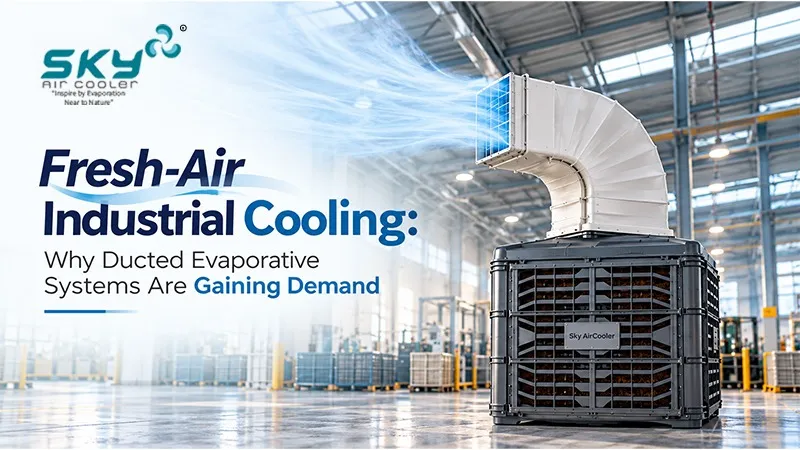
Sky Air Cooler, is a leading manufacturer and exporter of industrial evaporative air cooling systems. As factories, warehouses and production facilities look for practical ways to move fresh cooled air across large working areas, ducted evaporative cooling is becoming increasingly relevant. A properly planned Industrial Duct Cooler can distribute cooled outside air to selected zones rather than depending only on air movement around a single cooler location.
Why Fresh-Air Cooling Matters in Industrial Spaces
Large industrial buildings operate differently from enclosed offices or residential rooms. Production areas may have high roofs, large floor plates, open shutters, machinery and continuous movement of people and materials.
Evaporative cooling addresses these conditions by drawing warm outside air through water-saturated cooling pads. Water absorbs heat from the incoming air through evaporation, after which the cooler supplies fresh cooled air into the building. Stale indoor air can then move out through available doors, vents and louvres.
The important difference is continuous fresh-air movement rather than repeatedly circulating the same enclosed air.
This approach is particularly suited to applications where the building needs both air movement and cooling across occupied working zones.
How a Ducted Evaporative Cooling System Works
A ducted system combines an industrial evaporative cooler with a planned air-distribution route. Instead of releasing all cooled air immediately beside the machine, ducts carry that air toward selected sections of the facility.
The operating process can be understood in four stages:
- Warm outside air enters the cooler. The blower draws ambient air toward the cooling section.
- Air passes through wet cooling pads. Water circulated over the honeycomb pads absorbs heat as evaporation takes place.
- Fresh cooled air leaves the cooler. The cooler produces a continuous supply of conditioned outside air.
- Ducting distributes the air. Planned outlets deliver the airflow into the required production, storage or working zones.
Sky Air Cooler states that airflow direction, cooler positions, duct runs and discharge points can be mapped before installation as part of system planning.
Why an Industrial Duct Cooler Is Gaining Demand
Industrial buyers are increasingly focused on how cooling reaches the people and processes that actually need it. Simply installing a high-airflow machine does not automatically create the desired air distribution across a complex industrial layout.
Ducting gives designers greater control over where the cooled air is delivered. This can be useful for long production floors, high-roof buildings, warehouses and facilities where a cooler must be positioned away from the main working zone.
Several practical characteristics contribute to this demand:
- Fresh outside air supply: Evaporative systems continuously bring outside air into the facility rather than operating as a closed recirculation loop.
- Directed airflow: Ducts can route cooled air toward selected areas of a plant or warehouse.
- Large-space application: Industrial units are designed for production sheds, godowns and similar large working environments.
- Open and semi-open suitability: Evaporative cooling can operate in ventilated environments where doors or shutters may remain open.
- No refrigerant-based cooling cycle: The process uses water and airflow rather than CFC or HFC refrigerant gases.
These characteristics make system layout just as important as cooler capacity.
Ducted Cooling vs Direct-Discharge Cooling
Both arrangements use evaporative cooling, but their air-delivery methods serve different layout requirements.
|
Criteria |
Ducted Evaporative Cooling |
Direct-Discharge Cooling |
|
Air delivery |
Routed through ducts |
Released directly from the cooler |
|
Distribution |
Can serve planned zones |
Concentrated around discharge direction |
|
Layout flexibility |
Suitable for defined air routes |
Suitable where direct airflow reaches the required area |
|
Typical planning need |
Duct route and outlet positioning |
Cooler position and discharge direction |
|
Suitable building type |
Large or divided industrial layouts |
More open layouts with clear airflow paths |
The correct configuration depends on the building layout, roof height, airflow requirement and where cooling is actually required.
Choosing the Right Industrial Duct Cooler Configuration
Cooling capacity alone should not drive an industrial purchase. Buyers also need to consider how the air will travel after leaving the cooler.
The Sky Air Cooler industrial evaporative range is listed with airflow capacities from 18,000 to 40,000 CMH, with multiple models and top- and bottom-discharge configurations. The company's indexed regional product information specifically notes that top-discharge versions can be used with ducting.
Before selecting a system, buyers should review:
- Total area and roof height
- Location of machinery and major heat-producing zones
- Number and location of occupied working areas
- Suitable cooler installation points
- Required duct routes and discharge locations
- Existing doors, openings, vents and exhaust arrangements
- Access required for routine servicing and maintenance
A site-specific layout can help match the cooler and air-distribution arrangement to the actual building rather than treating every industrial space alike.
Fresh Air Distribution Can Be More Important Than Spot Cooling
Industrial comfort depends on more than placing a cooler near a workstation. In a wide or complex facility, the air needs a clear path from the cooler to the occupied zone and then toward an outlet from the building.
This is where an Industrial Duct Cooler becomes particularly useful. Ducting can take the cooled air across distance, around structural constraints and toward defined work areas.
A well-planned air path connects cooling capacity with actual air delivery.
For B2B buyers, this makes airflow mapping, cooler position and duct design important parts of evaluating an industrial evaporative cooling proposal.
Applications for Ducted Fresh-Air Cooling
The company positions its industrial evaporative coolers for large working environments such as production sheds, warehouses and industrial plants. Its website also identifies applications across textile mills, plastic and rubber units, engineering workshops, packaging environments and other industrial spaces.
A ducted approach can be particularly relevant when one or more working areas are separated from the most practical cooler installation location.
Rather than evaluating only the machine, buyers should assess the complete airflow system: cooler, inlet air, cooling pads, blower, duct route, discharge points and exhaust path.
Why Choose Us
At Sky Air Cooler, we manufacture industrial evaporative air coolers at our own facility in Gandhinagar and provide systems designed for large industrial working environments. Our website lists industrial models from 18,000 to 40,000 CMH with top- and bottom-discharge configurations, while our planning approach considers airflow direction, cooler positioning and duct routes before deployment. We focus on helping B2B buyers select a cooling arrangement based on their facility layout and actual air-distribution requirement.
Conclusion
Demand for fresh-air industrial cooling is growing alongside the need for better airflow distribution across large factories, warehouses and production spaces. A correctly selected Industrial Duct Cooler combines evaporative cooling with a planned distribution system that carries fresh cooled air toward the areas where it is required. For facilities with high roofs, large floor areas or defined working zones, duct routing can provide greater control over air delivery. Sky Air Cooler offers industrial evaporative cooling configurations and system-planning support for businesses evaluating this type of fresh-air cooling solution.
Planning fresh-air cooling for your factory, warehouse or production facility? Contact Sky Air Cooler to discuss your site layout, airflow requirements and suitable industrial evaporative cooling configuration. Call: +91 6353096801 or email info@skyaircooler.com.
Planning fresh-air cooling for your facility?
Share your industrial cooling requirement with our team and get guidance on a suitable ducted evaporative cooling solution for your facility.
Frequently Asked Questions
An industrial duct cooler is a system that uses evaporative cooling to provide fresh, cooled air to large industrial spaces. It works by drawing warm outside air through water-saturated cooling pads, where the air is cooled before being distributed through ducts to designated areas of a facility.
Fresh-air distribution is crucial in industrial settings because it ensures that cooled air reaches occupied working zones effectively, rather than recirculating stale air. This approach enhances comfort and productivity in large spaces such as factories and warehouses where air movement is vital.
Ducted evaporative cooling systems offer several advantages, including continuous fresh air supply, the ability to direct airflow to specific zones, and suitability for large industrial environments. Unlike traditional cooling systems, they operate without refrigerants, making them more environmentally friendly.
Choosing the right industrial duct cooler configuration involves considering factors like the total area, roof height, location of heat-generating machinery, and occupied working zones. It's essential to develop a site-specific layout that optimizes airflow and ensures efficient cooling distribution.
Ducted evaporative cooling systems are particularly suitable for large or divided industrial layouts where precise air delivery is needed. They can effectively operate in open or semi-open environments, making them a versatile option for various industrial applications.