
Key Takeaways
- Understand the significance of airflow capacity for large spaces when choosing a Commercial Evaporative Air Cooler.
- Consider cooling pad quality and water tank size to optimize efficiency and reduce maintenance costs.
- Jumbo Cooler Manufacturers in India offer specialized solutions for the unique cooling needs of industrial environments.
- Evaluate installation types based on space layout to ensure effective air distribution and comfort.
- A well-chosen commercial cooler can provide significant long-term savings compared to traditional air conditioning systems.
Choosing the right cooling system for a large commercial space is an important decision. Warehouses, workshops, factories, restaurants, event venues, showrooms, gyms, and other large areas have different cooling requirements from residential rooms. A standard household air cooler may not provide the airflow, coverage, or performance needed for a spacious environment. This is where selecting the right Commercial Evaporative Air Cooler becomes important.
Large spaces require a practical approach to cooling. The size of the area, ceiling height, ventilation, number of occupants, heat generated by equipment, local climate, and intended usage can all influence the type and capacity of cooler required. Choosing a unit based only on appearance or price may result in inadequate cooling or unnecessary operating costs. A better approach is to understand the application first and then select equipment that matches the space.
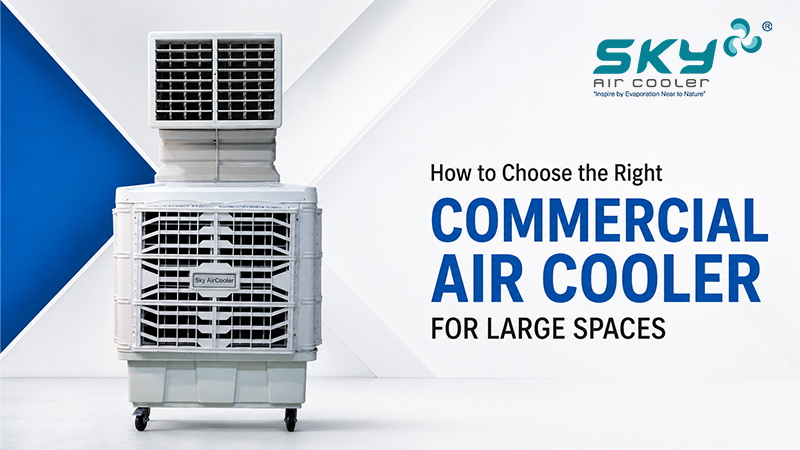
Sky Air Cooler provides commercial cooling options designed for larger applications. Its commercial air cooler category includes models such as the Earth 18000 CMH Commercial Air Cooler and Earth 22000 CMH Commercial Air Cooler, giving businesses options to consider according to their cooling requirements.
Why Large Spaces Need a Different Cooling Approach
Domestic air cooler is meant for a house room of several hundred square ft. Move the same unit into a 10,000 square foot warehouse, and it will not be able to circulate as much air as it needs to noticeably affect the environment. This is where machines that can deliver cool air over a long distance, operate for long periods and tolerate dust, heat and humidity generated over prolonged use are necessary.
That’s where a Commercial Evaporative Air Cooler proves to be the ideal solution. Evaporative cooling systems use a few waters soaked cooling pads to cool the hot air naturally which reduces the temperature without using heavy compressors and refrigerants like those in air conditioners. This approach can provide comfort in large open spaces with high ceiling and frequent movement in the room at a much lower power consumption compared to the traditional AC systems.
Key Factors to Consider Before You Buy
1. Airflow Capacity
Airflow rating (Cubic Meters per Hour (CMH)) is the most important number for comparing coolers. A small-sized unit (few thousands of CMH) will disappear from a big factory floor. If you’re looking for coolers that can handle larger areas, you will have to go for the coolers that fall in the higher CMH range, which are generally manufactured by Jumbo Cooler Manufacturers in India for industrial or commercial scales.
The volume of the space (not simply the floor area) determines the CMH rating. Ceiling height adjusts the amount of air volume to be cooled.
2. Coverage Area and Layout
Plan the area before you narrow down to a model. Does it have one open floor or is it divided into sections by machines, partitions or storage racks? The air flow situation changes in an open banquet hall vs a warehouse crammed with shelves. Commercial Evaporative Air Coolers, if installed without consideration of obstructions, will create dead space where air flows slightly. Design for multiple units that will provide cross-ventilation, not just one, large unit in a corner.
3. Cooling Pad Quality
The cooling pad is the central part of any evaporative unit. The thicker pads, honeycombed pads, will retain more water and will help to cool the air better than thin aspen pads. In addition, pads must not build up with algae and must last longer in continuous industrial use, because the more often the pads are replaced, the more maintenance expense is incurred. In case you are comparing with any Jumbo Cooler Manufacturer in India, make sure to always inquire about the thickness of the pads and the estimated life of the pad.
4. Water Tank Size and Refill Frequency
Water tanks need to be large enough to not require constant water refilling when a large cooler is operating for 8, 10 or 12 hours a day. If downtime is not possible, as in factories or event venues, look for models that offer larger tank capacities or, ideally, continuous water-supply connections for an all-day operation.
5. Build Quality and Body Material
The working conditions at an industrial plant can be harsh. All of this dust, vibration and outdoor positioning take its toll. Metal-bodied coolers with galvanized or powder-coated metal bodies are much more durable than plastic-bodied coolers intended for use at home for cooling over the years.
A commercial cooler specifically designed for a factory or warehouse environment should be constructed to withstand the rough treatment of day to day operation without frequent breakdowns and the body material is frequently the deciding factor on whether a machine will last for 10 years or can be replaced after a couple of seasons.
6. Noise Levels
Noise is a concern in the offices, showrooms or hospitality space. Find models that have well-balanced motors and fan blades to reduce vibration. Where there is no other purpose, such as a manufacturing facility, noise is less of an issue, while in a space where customers will be interacting with the work, noise can have an impact on the overall experience.
7. Energy Consumption
The reason that most of the businesses opt for the evaporative cooling systems over air conditioning is related to the power consumption. The Commercial Evaporative Air Cooler is an inexpensive option to a similar size AC due to the fact it does not use a compressor.
This difference certainly comes into play when calculating savings in the electric bill over a full cooling season and is even more important in spaces that are kept cool for 10 or more hours each day.
8. Installation Type: Ducted, Wall-Mounted, or Portable
In a large space, a sunspace may require a system with ducts which distribute cool air to various outlets through the space. Some prefer to use wall-mounted or stand-alone units spaced apart. Consider installation type after identifying how the space is used on a day-to-day basis.
Fixed workstations, like a factory floor, can be best supplied by ducted delivery, whereas the banquet hall, which may change layout often, can benefit from portable delivery.
Common Sizing Mistakes Businesses Make
Even the most experienced facility managers can sometimes get it wrong, and there are a few common patterns of errors. The first is using the floor area to calculate cooling requirements rather than taking into account the ceiling height, and the real air volume is severely underestimated in warehouses with high ceilings.
The second is to location the entire cooling capacity in one large unit rather than being divided into multiple smaller units that produce good airflow near the unit and little or no airflow at the opposite end of the building.
The third is to completely ignore getting people off to ventilate; an evaporative cooling house must have a constant flow of air moving in and out, and there must be sufficient open windows, vents, or exhaust points to allow hot air to leave while cool air enters. If the exchange doesn’t take place, humidity accumulation inside and the cooling performance will significantly decrease after a few hours of use.
Matching the Cooler to Your Industry
Different industries put different demands on cooling equipment.
Warehouses and Godowns: Need high-CMH units with wide throw distance to cool long, narrow spaces without dead spots near the back walls.
Manufacturing Units and Factories: Often combine heat from machinery with high occupancy, so airflow needs to be strong and continuous, and the cooler body needs to withstand dust and vibration.
Banquet Halls and Event Venues: Need quieter operation and even air distribution across an open floor where guests are seated, without cold spots near the units and stale air farther away.
Gyms and Fitness Centers: Generate a lot of body heat and need continuous airflow to keep the space comfortable during peak hours.
Retail Showrooms: Prioritize a balance of cooling performance and low noise, since customers spend extended time browsing indoors.
Sky Air Cooler builds units across these use cases, drawing on its position as a Jumbo Cooler Manufacturer in India that understands the operational demands of each setting rather than offering a one-size-fits-all product.
Maintenance Considerations for Long-Term Performance
A commercial cooler is a long-term investment, and its performance depends heavily on upkeep. Cooling pads should be checked periodically for mineral deposits and replaced when airflow through them weakens. Water tanks need occasional cleaning to prevent algae growth, especially in humid climates. Motors and pumps should be inspected before each cooling season begins.
Businesses that build a simple maintenance schedule around these checkpoints get a noticeably longer working life out of their coolers and avoid unexpected downtime during peak summer months.
Why choose us
Sky Air Cooler has built its reputation as a dependable Jumbo Cooler Manufacturer in India, with a manufacturing base in Gandhinagar, Gujarat, and a product line that covers commercial and industrial cooling needs across sectors such as warehousing, manufacturing, hospitality, and retail. The team focuses on building coolers with strong airflow ratings, durable metal bodies, and cooling pads designed for continuous operation, so businesses get equipment that holds up under real working conditions rather than just on a spec sheet. Customers also get planning and mapping assistance to help identify the right number of units and placement for a given space, along with after-sales service and maintenance support once the coolers are installed. Add to that a range that spans multiple CMH capacities and configurations, and businesses get a manufacturer that understands both the engineering and the day-to-day reality of running large cooling systems, which makes the buying decision considerably easier for facility managers who need a solution they can rely on across every cooling season.
Conclusion
Selecting the right commercial air cooler for a large space comes down to matching airflow capacity, build quality, and installation type to how the space is actually used. Ceiling height, layout, occupancy, and industry all influence the right choice, and cutting corners on any of these factors leads to uneven cooling and higher long-term costs. A well-chosen Commercial Evaporative Air Cooler delivers steady comfort at a lower running cost than conventional air conditioning. Working with an experienced manufacturer that understands large-scale cooling, like Sky Air Cooler, makes it far easier to get the sizing and setup right the first time, saving both money and future maintenance trouble.
Want expert help choosing the right commercial cooling setup for your space? Our team can guide you through capacity planning and product selection for warehouses, factories, and event venues. Call us at +91 6353096801 or email support@skyaircooler.com
Frequently Asked Questions
What factors should I consider when choosing a Commercial Evaporative Air Cooler?
When selecting a Commercial Evaporative Air Cooler, consider factors such as airflow capacity (measured in CMH), coverage area, cooling pad quality, water tank size, build quality, noise levels, energy consumption, and installation type. Each of these will impact the performance and efficiency of the cooler in large spaces.
How is a Jumbo Cooler Manufacturer in India different from regular air cooler manufacturers?
A Jumbo Cooler Manufacturer in India specializes in producing large-capacity coolers designed for commercial and industrial use. These coolers typically have higher airflow capacities and better durability to handle the demands of larger spaces, unlike regular air coolers designed for residential use.
Why can't I use a standard air cooler in a large warehouse?
Standard air coolers are generally designed for smaller spaces and lack the airflow capacity needed for large warehouses. Inadequate airflow can lead to uneven cooling and insufficient temperature control, making it essential to use a Commercial Evaporative Air Cooler tailored for such environments.
What is the importance of cooling pad quality in Commercial Evaporative Air Coolers?
The cooling pad is crucial in an evaporative cooler as it directly affects cooling efficiency. High-quality, thicker cooling pads retain more water and perform better, leading to improved air cooling and reduced maintenance frequency.
How can I determine the right size of a Commercial Evaporative Air Cooler for my space?
To determine the right size of a cooler, calculate the cubic meters of air that need to be cooled by considering the entire volume of the space, including ceiling height. It’s also vital to assess the layout and airflow requirements to avoid dead spots, which might mean using multiple smaller coolers for better distribution.